Five marks show up on clean-beauty packaging, they look interchangeable, and they check almost entirely different things. A product can carry all five or none, and the presence of one tells you nothing about the others. Here is what each one verifies, where each is stricter than us, and where the honest answer is "this seal doesn't cover that."
We run one of these certifications. Read the comparison with that in mind — we've tried to write it as if a rival certifier will check it, because that's the only version worth linking to.
The one-line version
| Seal | What it actually verifies | What it does not |
|---|---|---|
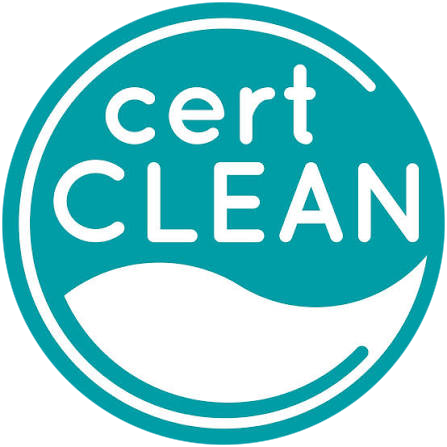
| CertClean | Every ingredient screened against a published restricted list; certificate issued per assessed product, renewed annually | Efficacy, sustainability, animal testing, whether it suits your skin |
| MADE SAFE | Ingredients screened against a banned-list plus a hazard-based "toxicant" screen; broader than beauty (also bedding, baby, household) | Efficacy, performance; it is not primarily an organic or cruelty standard |
| EWG Verified | Meets EWG's ingredient criteria, full transparency including fragrance constituents, no ingredients on their "unacceptable" list | Efficacy; the underlying hazard scoring is contested by many toxicologists |
| Leaping Bunny | No animal testing at any stage, including suppliers, with supply-chain monitoring and audits | Ingredient safety, formulation, whether it's natural or organic |
| COSMOS / Ecocert | Organic and natural content thresholds, permitted processes, environmental and packaging criteria | Whether a non-organic product is "safe"; animal testing specifics; efficacy |
Read down the right-hand column. Every one of these seals has a large blank — a thing people assume it covers that it does not.
Where each is stricter than we are
Leaping Bunny is unambiguously stricter than CertClean on animal testing, because we don't assess animal testing at all. If cruelty-free is your priority, our seal is not the one to look for — theirs is, and it's the most rigorous widely-used one, because it reaches into the supply chain rather than covering only the finished product.
COSMOS / Ecocert is stricter on organic sourcing and environmental process. We don't verify organic content or agricultural practice; a product can be fully CertClean-certified with no organic ingredients in it. If "certified organic" is what you're after, that's their standard, not ours.
MADE SAFE and EWG Verified overlap with us most, because all three screen ingredients against restricted lists. They differ in method. Both lean harder than we do on hazard-based screening — flagging an ingredient because it has a documented hazard at some dose, which is the approach toxicologists most often criticise for not weighting the dose achievable through cosmetic use. Whether that makes them stricter or just differently calibrated is a genuine methodological disagreement, not a ranking.
Where we think our approach holds up
Our claim is deliberately narrow: we screen every disclosed ingredient against a published restricted list and issue a certificate per product, renewed each year rather than granted once. We don't tell you the product is safe, works, or is good for the planet — because we don't test any of those, and neither, in most cases, do the others, whatever the packaging implies.
That narrowness is the point. A seal that claims less is a seal that can be checked. The failure mode for this entire category is a mark that implies a broad guarantee of safety and virtue while actually verifying one specific thing — and then trading on the gap between the two.
How to read a stack of seals
Match the seal to the question. Cruelty-free? Leaping Bunny. Organic? COSMOS. Ingredients screened against a restricted list? Any of CertClean, MADE SAFE, EWG. Nobody's seal answers "will this work," because none of them test efficacy.
More seals is not strictly better. Certification costs money, and a two-person brand may hold one mark and skip four it couldn't afford, while a larger brand collects all five as a marketing exercise. The number of logos is partly a budget signal, not only a virtue signal.
No seal is not a red flag. Plenty of excellent products carry none, usually because the maker would rather spend the certification fee on ingredients. The seal makes a claim checkable; its absence doesn't make a product suspect.
What none of them do
Not one of these marks — ours included — evaluates whether a product performs, whether it suits your skin type, or whether it's worth the price. Those remain your call, informed by the ingredient list, your own skin, and a realistic trial period. A certification narrows the field to products that meet a defined standard. It doesn't pick for you, and any seal that implies it does is overreaching.