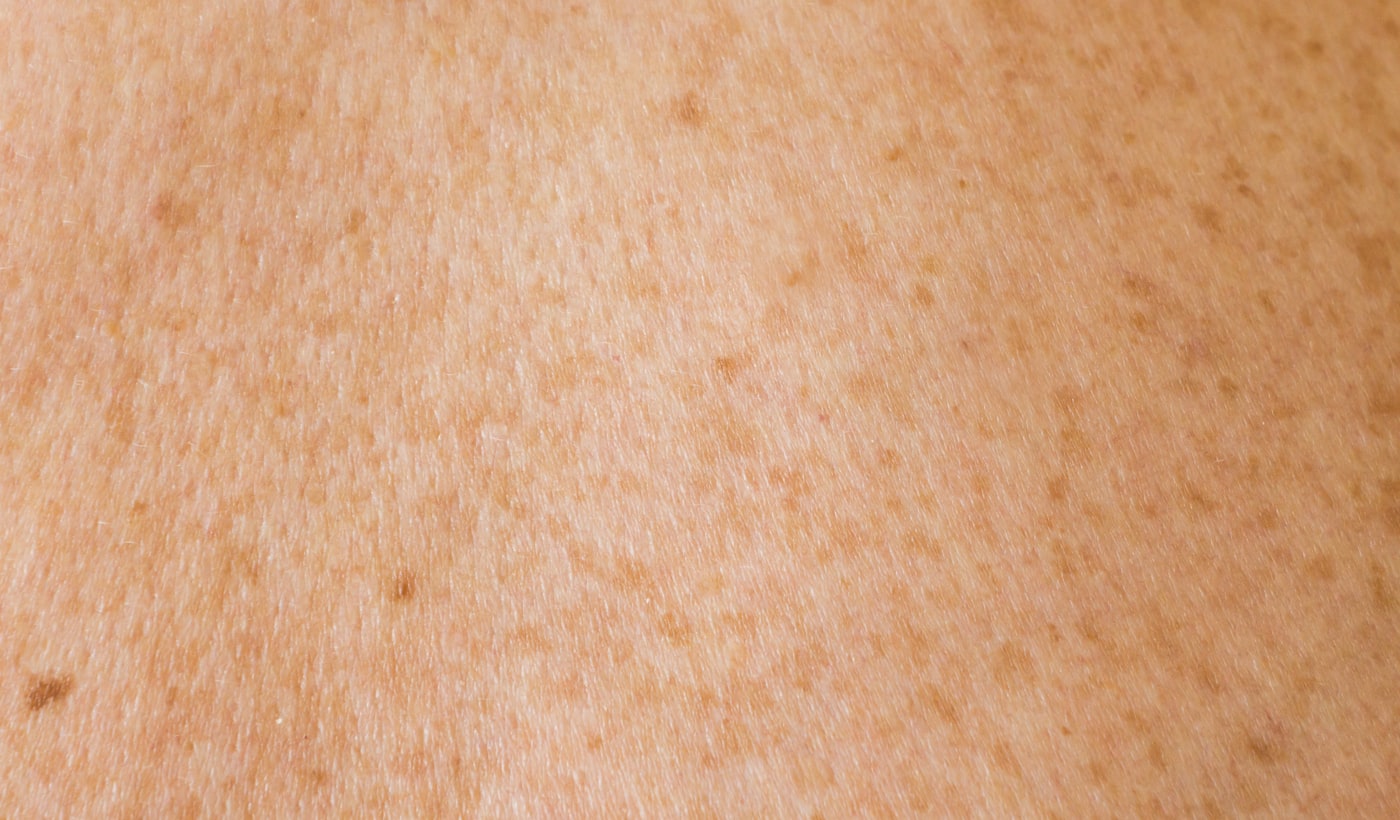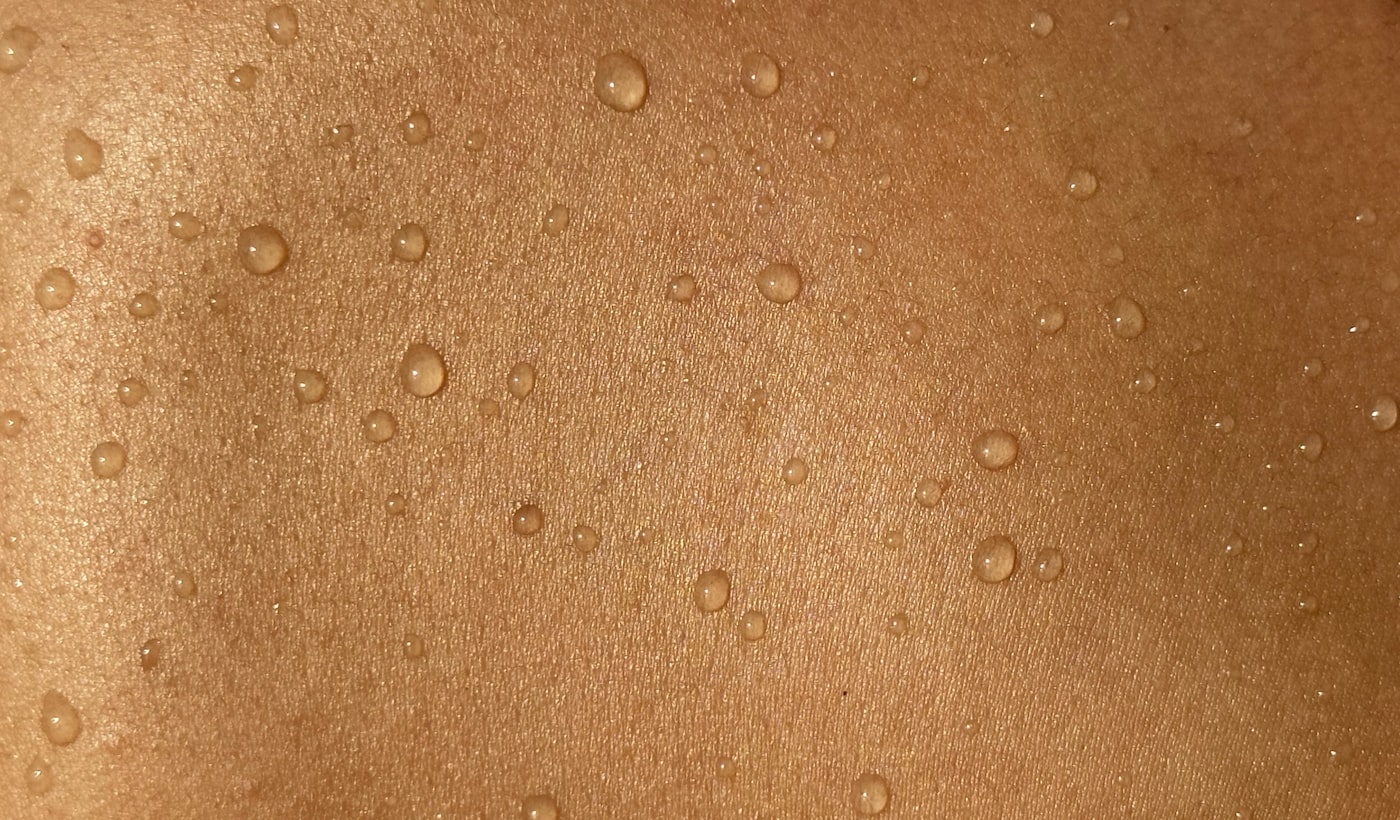

You've probably encountered the claim that 60% of what you apply to your skin ends up in your bloodstream. It has no identifiable source and it isn't true. But the honest correction isn't "nothing gets in" — nicotine patches work, and so do hormone patches, and so does fentanyl. Some things absolutely get through skin. The useful question is which ones, and at what dose, and whether that dose does anything.
This is the piece of science most often bent in both directions. One camp uses it to sell fear. The other uses it to dismiss every concern as hysteria. The answer is specific and knowable, and it's mostly determined by molecular size.
The barrier is the bottleneck
Almost all resistance to absorption comes from the stratum corneum — that twenty-micrometre layer of dead cells and lipid. Once a molecule is past it, the living epidermis and dermis are comparatively easy going, and the dermis is full of capillaries.
Most molecules take the intercellular route: winding through the lipid mortar between cells, a tortuous path many times longer than the layer is thick. A minority pass through the cells themselves. A small fraction take the shortcut down hair follicles and sweat ducts, which occupy a tiny fraction of your surface area but matter more than you'd expect for large particles.
Size is the first filter
The most useful rule of thumb comes from a 2000 paper by Bos and Meinardi: molecules above roughly 500 daltons don't cross intact skin in meaningful amounts by passive diffusion. It's a rule of thumb, not a law — but it holds well enough to be worth applying to marketing copy.
Run some cosmetic ingredients through it:
Hyaluronic acid. Standard cosmetic-grade HA runs into the hundreds or thousands of kilodaltons. Even the "low molecular weight" fragments sold as deeper-penetrating are typically several thousand daltons — an order of magnitude over the threshold. HA works by holding water at the surface. It is not travelling anywhere, and it doesn't need to.
Collagen. Around 300 kilodaltons. A collagen molecule cannot enter your skin, and if it did, your body has no mechanism for installing someone else's collagen where yours used to be. Topical collagen is a humectant and a film former. Those are real, modest benefits, honestly describable.
Peptides. Varies enormously. Short chains can be small enough to have a plausible route in. Longer ones can't. "Peptide" on a label tells you nothing about size on its own.
Size isn't the only factor. A molecule also needs the right balance of oil- and water-solubility — too water-loving and it won't enter the lipid matrix, too oil-loving and it won't leave it. Charge, the vehicle it's dissolved in, whether the area is occluded, where on the body it is, and whether the skin is already inflamed all shift the outcome substantially. Damaged skin is far more permeable than intact skin, which is why the advice differs for eczema.
What does get through

Small, fat-soluble molecules. That's the profile transdermal drug delivery is built around: nicotine, estradiol, testosterone, scopolamine, glyceryl trinitrate, fentanyl. All small. All lipophilic. All delivered under occlusion, over hours, at engineered doses.
Note how much engineering that takes. Getting a drug reliably through skin is difficult enough that formulating a patch is a specialist discipline. That difficulty is the barrier doing its job.
The distinction that resolves most of the argument
Detection is not dose, and dose is not harm.
Analytical chemistry can now find substances at parts per trillion. Finding a metabolite of a cosmetic ingredient in someone's urine confirms that exposure occurred. It does not establish that the amount was biologically meaningful. Nearly every "found in the blood of study participants" headline collapses these into each other.
The best illustration is the FDA's own sunscreen work. In 2019 and 2020 the agency ran trials applying organic UV filters at maximal-use conditions and measured plasma concentrations. Several filters exceeded the threshold above which the FDA requires additional safety data. That happened, and it was reported accurately.
What the FDA also said, explicitly, was that absorption is not the same as harm, that the data gap needed filling, and that people should keep using sunscreen in the meantime. Both halves of that are the story. A version that reports only the first half is scaremongering; a version that reports only the second is dismissive.
What this means for reading a label
"Penetrates deep into skin" is usually false, and usually good news. For a moisturiser, staying put is the mechanism. Depth is not a quality signal.
Molecular size is a quick sanity check. If a large molecule is claimed to act inside the dermis, the claim needs more explanation than the label is giving.
The exposures worth thinking hardest about share a profile: small molecules, leave-on products, large surface area, applied daily over years. A body lotion used head to toe every day for a decade is a different exposure question from a face cream used at a pea-sized dose. Neither is inherently alarming. They're just not the same question, and they're routinely treated as if they were.
What we don't know
Aggregate exposure is the open question. Most safety assessment evaluates one ingredient in one product at a time. A person using a dozen products daily is exposed to the same handful of common preservatives, filters, and fragrance materials across all of them simultaneously. Cumulative and mixture effects are studied far less than single-ingredient toxicology, largely because they're methodologically hard.
That's a legitimate gap. It's also frequently overstated — "we haven't fully characterised this" is not the same as "this is causing harm," and the leap between those two sentences is where a great deal of marketing lives.
There are also population gaps. Absorption studies are usually run on healthy adult skin. Infants have a higher surface-area-to-weight ratio and a less mature barrier. People with eczema have compromised skin over large areas. The data on both is thinner than it should be.